
| Help Support Meru Foundation Research |
 |
The quotation below is from The Zohar in Moslem and Christian Spain, by Ariel Bension, Ph.D., Sepher-Herman Press, New York, 1974.
From Chapter VIII, The Revelations Made To The Great Holy Assembly, The Revelation of the Mystery of the Existence of God, pp. 120-121 (emphasis added in each case):
"Now let us try to understand the science of the Sacred Unity. Look at the flame of a lamp; First, we see two lights, one of a brilliant whiteness, the other dark, or bluish. The white light is above and rises in a straight line; the dark light is below and seems to form the base for the other. But so closely joined are they that they appear to us as a single flame. But the base, which is the dark light, is attached to the wick which is under it. The white light preserves its luminous whiteness at all times unchanged, while the lower, dark light, seems to consist of many nuances. The dark light acts in two opposite directions: above, it is attached to the white light, while below, it is attached to the material which feeds it and, being gradually absorbed into it, rises to the upper or white light. Thus are all things absorbed into the Supreme Whole."
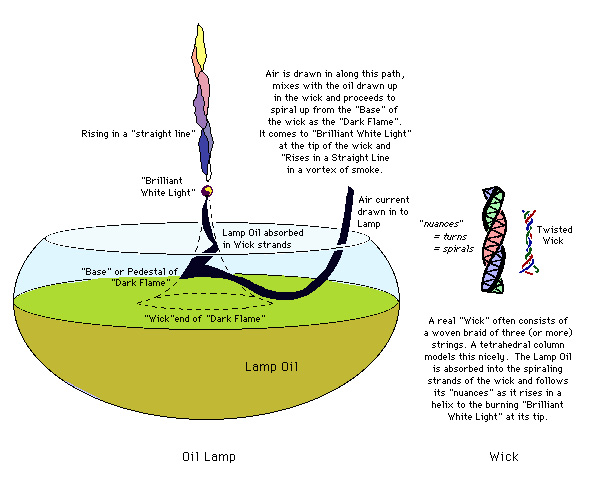
With regard to the tetrahedral column representing a lamp wick:
This is from Gregory Vlastos' Plato's Universe, Univ. of Washington Press, 1975, p. 86:
"To decide the case for Plato the facts would have to show, for example, that the liquid has a water content which consists of icosahedra, and that the fiery part of the burning wick consists of tetrahedra."
Vlastos is discussing Plato's traditional association of the geometrically
fluid icosahedron with the "element" of water (or the lamp oil)
that is drawn up by the wick and the tetrahedron with the "element"
of fire. This is a particularly apt and elegant description when the wick,
from which the flame-tetrahedra erupt, is itself a column of tetrahedra,
i.e., a tetrahelix. The tetrahelix neatly weaves three strands into a wick. 
Contents of this page are ©1997 Stan Tenen,
and licensed to Meru Foundation, 524 San Anselmo Ave. #214, San Anselmo, CA 94960.
Email inquiries to: meru@meru.org;